

7 Ways Clothing Influences Your Daily Mindset
Last Updated: November 4, 2026
Quick Summary
Yes, clothing influence on your daily mindset is real: enclothed cognition research shows what you wear, and the meaning you attach to it, shapes your attention, confidence and behaviour. The effect only activates when you choose a piece deliberately and it carries symbolic meaning for you.
- Clothes chosen on autopilot do nothing for your mindset; the enclothed cognition effect stays dormant.
- Inherited identity, fear of being seen and decision fatigue are the three barriers keeping you dressing on autopilot.
- Move the decision out of the morning: choose your piece the night before and put it where you will see it first.
- Start a growth wardrobe with subtraction, not addition, and add one purposeful piece at a time.
- Anchor identity in the intention a garment carries rather than the number on the label.
Table of Contents
- The Science of How Clothing Influence Works on Your Mind
- Enclothed Cognition and Personal Growth: The Psychological Link
- Intentional Fashion for Self-Discovery: Dressing the Person You're Becoming
- Clothing That Supports Personal Evolution: Choosing Pieces with Purpose
- Three Psychological Barriers That Keep You Dressing on Autopilot
- How Your Wardrobe Can Reinforce Inner Work and Healing
- Building a Wardrobe That Reflects Your Growth
- Frequently Asked Questions
The Science of How Clothing Influence Works on Your Mind
Does clothing influence your daily mindset? Yes, and the research is clearer than most people expect. A Northwestern University study on enclothed cognition found that what you wear, and the meaning you attach to it, shapes your attention, confidence and behaviour. Destined 4 Greatness builds on that idea: the right piece can carry a message you need to hear before you leave the house.
What the Research Actually Shows
Enclothed cognition is the mental shift that happens when clothing carries symbolic meaning for the wearer. The effect is generally described as depending on two things: noticing what you're wearing, and it meaning something to you.
Analysis cited by PMC research on dress and person perception shows clothing sits at the centre of how people read each other. It also changes how you read yourself.
Why Intention Changes Everything
Here's the part most style advice skips. Clothes chosen on autopilot do nothing for your mindset. The enclothed cognition effect stays dormant.
The difference comes down to one question: did you pick this on purpose?
Enclothed Cognition and Personal Growth: The Psychological Link
Personal growth runs on small, repeated signals. Clothing is one of the few you send yourself every single day.
Put on a piece that means something and you prime focus, calm or courage before the day starts. Skip that step and you hand the morning over to habit. That link between enclothed cognition and personal growth is why intentional fashion matters for growth as a daily practice, not a one-off wardrobe overhaul.
Intentional Fashion for Self-Discovery: Dressing the Person You're Becoming
Intentional fashion for self-discovery flips the usual question. Instead of asking what looks good, you ask who you're becoming, then dress for that person.
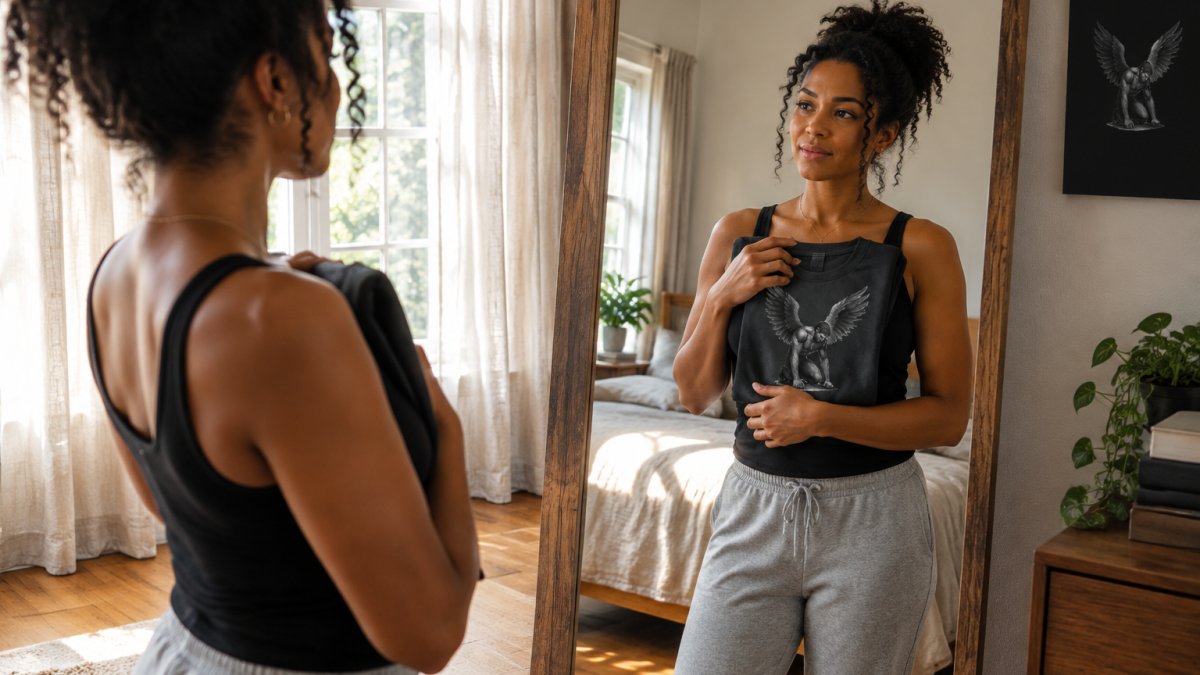
The woman is Australian.
This is identity work you can do before breakfast. A person rebuilding confidence after a hard season can wear that intention visibly. A person stepping into a new chapter can mark it on day one.
It sounds small. Repeated daily, it isn't.
Clothing That Supports Personal Evolution: Choosing Pieces with Purpose
Clothing that supports personal evolution passes one test: does it remind you who you're trying to be? If the answer is no, it's just fabric.
Purpose-driven pieces work because the symbol does the reminding. A bold emblem, a word you believe in, a colour that lifts you. The garment becomes a cue, not a costume.
Destined 4 Greatness designs its menswear around exactly this idea. The Eagle Graphic Tee carries a vintage-style eagle emblem across the chest in a heavyweight cotton body. The Gold Eagle Hoodie does the same job in a soft midweight blend for colder mornings.


One customer, Jason M., put it plainly: "It doesn't just look good, it inspires good. Power clothing with a purpose."
Three Psychological Barriers That Keep You Dressing on Autopilot
Many people don't choose their clothes each morning. They repeat habits formed over time. Three barriers keep that loop running, and each one has a way through it.
1. Inherited identity. You dress for a version of yourself someone else approved, not the one you're growing into. The conditioning runs deep: a parent's comment about what suits you, a school uniform, a workplace that rewarded a certain look. Over time those voices become the default setting, and you stop noticing you never chose it. Perspectives of the Analytical Mind examines how family, culture, education and authority quietly shape the identity you wear, and it is a useful mirror for spotting which of your clothing choices were never really yours. The way through is to ask, for each habitual piece, whose approval it was originally seeking.
2. Fear of being seen. Standing out feels risky, so you blend in. The cost is that your outsides stop matching your insides, and that mismatch quietly erodes confidence. This is not vanity; it is the enclothed cognition effect running in reverse. Some people doing inner work still dress for the version of themselves they are trying to leave behind. How to Tap Into Your Divinity addresses this directly through shadow work and the move beyond external validation, because the fear of being seen is usually a fear of being judged by a standard you never agreed to.
Destined 4 Greatness Eagle Graphic Tee — Oversized Men’s Streetwear T‑Shirt →
3. Decision fatigue. By morning, willpower is thin. The easiest option wins, and the easiest option is whatever sits on top of the pile. This is a design problem, not a character flaw. The fix is to move the decision out of the morning entirely: choose the piece the night before, and put it where you will see it first. A single deliberate choice, made when you are calm, removes the need to make it again when you are tired.
Naming the barrier is half the work. The other half is one deliberate choice, made the night before, repeated until it becomes the new default. Sacred Scars is a useful companion here, because it traces how painful experience and old conditioning can become a pathway to greater awareness rather than a permanent identity. The barriers are not character flaws to be ashamed of. They are inherited patterns, and inherited patterns can be examined, named and replaced.
Watch out: if you try to change all three barriers at once, you will usually abandon the effort within a fortnight. Pick the one that costs you the most each morning and work on that one first.
How Your Wardrobe Can Reinforce Inner Work and Healing
Inner work changes how you see yourself. Your wardrobe can make that change visible, and visible change is easier to keep.
Healing is rarely linear. Some days it needs softness. Others need armour. A piece chosen with that in mind becomes a ritual: a small, physical act that says the inner work matters.
This is where the books and the clothing meet. How to Tap Into Your Divinity is a practical guide to breaking old patterns, strengthening the mind and reconnecting with the divine essence within. Sacred Scars traces how painful experience can become a pathway to wisdom. Pair either with a garment that carries your intention and the message lands twice: once on the page, once in the mirror.
Building a Wardrobe That Reflects Your Growth
A wardrobe that reflects growth starts with subtraction, not addition. Most people treat the wardrobe as a storage problem. It is really an identity problem: every garment you keep is a small vote for the person you were when you bought it.
Here is a framework that goes deeper than a checklist:
| Step | Action | The Inner Work Behind It |
|---|---|---|
| 1. Audit | Remove pieces tied to an old identity | Honest self-reflection: which garments do you reach for out of habit, obligation or fear? |
| 2. Name | Write down who you're becoming | Self-identity work: describe the person in one or two words, not a trend |
| 3. Choose | Add one purposeful piece at a time | Conscious decision-making: each addition must carry a message you need to hear |
| 4. Wear | Put the piece on during hard days | Accountability: the cue only works when it is repeated |
| 5. Review | Revisit the wardrobe each season | Discernment: notice what no longer fits the person you are becoming |
The audit is where most people stall, and the reason is emotional, not practical. Some people keep clothes tied to a version of themselves they are grieving, or a version they were told to be. Perspectives of the Analytical Mind is useful here because it examines how family, culture, education and authority quietly shape the identity you wear. Naming that influence is often what finally lets a garment go.
Cost-per-wear is a useful discipline, not a shopping rule. The idea is simple: divide what a piece cost by the number of times you actually wear it. A garment worn weekly for a year is doing far more work than one worn twice. The point is not to chase a number but to ask an honest question before you add anything: will this piece still be carrying my intention in twelve months? If the answer is no, it is a costume, not a cue.
Wardrobe lifecycle management matters more than the initial purchase. Rotate pieces seasonally so the ones that carry your intention are the ones you see first. Store the rest out of sight so the pile on the chair stops making your decisions for you. Repair rather than replace where you can, because the act of mending a garment you have chosen deliberately reinforces the same message the garment carries.
Body changes are part of the process, not a failure of it. Bodies fluctuate through illness, grief, training, pregnancy and age. A wardrobe built on a single fixed size will always be fragile. The more resilient approach is to anchor your identity in the intention the garment carries rather than the number on the label, and to keep one or two pieces that fit you now rather than the size you were.
Start with one piece. The men's oversized white shirt works as a daily anchor, and the vintage angel wing tee suits quieter days. Browse the full modern men's clothing range to find the piece that speaks to where you're headed.

Watch out: if you clear out the wardrobe in one emotional purge, you will often re-buy the same identity within a month. Audit slowly, and keep anything you are genuinely unsure about in a box for a season before deciding.
Frequently Asked Questions
Can clothing change your psychological state?
Yes. Research on enclothed cognition shows that what you wear, combined with the meaning you attach to it, influences your mindset, attention and behaviour. Research on enclothed cognition suggests clothing can influence cognitive processes. The effect depends on intention: when you choose a garment deliberately, it can reinforce focus, confidence or calm. When you dress on autopilot, that psychological effect stays dormant.
How does intentional fashion support personal transformation?
Intentional fashion turns getting dressed into a daily practice of self-reflection. Instead of reaching for whatever is clean, you ask what state of mind you want to carry into the day. This aligns with the inner work explored in How to Tap Into Your Divinity, which emphasises self-awareness and conscious decision-making. Over time, those small daily choices reinforce the identity you are building rather than the one you have outgrown.
What is the link between self-identity and the clothes we choose?
Clothing is one of the most visible expressions of identity. Some research suggests clothing choices can influence mood and confidence, and may support identity reinforcement. When you choose pieces that reflect your values and intentions, you signal to yourself who you are becoming. That is why Perspectives of the Analytical Mind encourages questioning inherited beliefs, including the ones that shape how you present yourself.
Does wearing clothing with affirmations influence daily behaviour?
Clothing carrying affirmations or meaningful symbols can serve as a wearable reminder of your intentions. The effect works best when the meaning is personal. A graphic tee or hoodie from Destined 4 Greatness only carries power if you connect it to a mindset you are actively practising. Pair the garment with reflection, journaling or reading, and it becomes an anchor rather than decoration.
The challenge is simple: stop dressing for the person you were. Destined 4 Greatness pairs resilient streetwear with soul-shifting books, so your outsides and insides move in the same direction. Shop the apparel, start with a book, and show up as the person you're becoming. Get started with Destined 4 Greatness and wear your intention every day.
