

7 Ways Resilient Streetwear Fuels Personal Growth
Last Updated: November 4, 2026
Quick Summary
Resilient streetwear is clothing chosen to reinforce identity, values and inner strength rather than to follow a trend. At Destined 4 Greatness, resilient streetwear works as a daily cue that supports the inner work, while the books do the deeper reconstruction clothing cannot.
- Write down three core values, not ten, before auditing your wardrobe.
- Pull out everything worn in the last ninety days and treat the rest as data.
- Ask which of your three values each garment expresses and how.
- Add a new piece only where one of your values has no garment attached.
- Repeat the audit each season because values shift as inner work progresses.
Table of Contents
- What Resilient Streetwear Means for Personal Growth
- The Psychology of Streetwear Symbolism and Self-Expression
- 1. Use Your Wardrobe as a Daily Affirmation of Identity
- 2. Overcoming Limiting Beliefs Through Identity
- 3. Build a Values-Driven Wardrobe That Reflects Core Values
- 4. Books for Spiritual Awakening and Healing to Pair With Your Practice
- 5. The Psychological Impact of Uniforming and Intentional Dressing
- 6. Sustainable and Ethical Production as a Personal Value
- Start With One Intentional Piece
- Frequently Asked Questions
What Resilient Streetwear Means for Personal Growth
Resilient streetwear is clothing chosen to reinforce identity, values and inner strength, rather than to follow a trend. According to Fortune Business Insights' streetwear market analysis, the global streetwear market is projected to reach AUD 616.85 billion in 2026, and wellness-focused pieces are now its fastest-growing category. That shift matters. At Destined 4 Greatness, the view is simple: what you wear can either distract you from your inner work or quietly reinforce it every morning.
The distinction is intent. A resilient wardrobe is curated, not collected. It carries symbolism you chose, it survives repeated wear, and it reminds you who you are becoming. Below, seven ways to build one, plus the reading that does the deeper work clothing cannot. For a closer look at how intentional clothing supports inner growth, read Intentional Fashion Matters for Growth.
The Psychology of Streetwear Symbolism and Self-Expression
Streetwear has always functioned as visual communication. A graphic, a cut, a colour signals belonging before a word is spoken. That is social signalling in its purest form, and it is why the category has always attracted people who want to say something about who they are without saying it out loud.
But symbolism works on two levels, and most commentary only covers one. The first is outward: the emblem, the slogan, the silhouette tell other people which tribe you belong to. The second is inward: the same garment tells you, every time you put it on, which version of yourself you are practising that day. The outward layer is social. The inward layer is personal growth, and it is the one that matters here.
A useful way to think about it is the difference between a symbol you inherited and a symbol you chose. A logo you bought because it was trending is an inherited symbol, it carries someone else's meaning. A piece you selected because it names a value you are actively working on is a chosen symbol, and chosen symbols do a different job. They act as cues. What you wear can shape how you think and behave, not because the fabric is magic but because a garment can remind you of the identity attached to it.
There is a limit worth naming. Research published in the Journal of Research in Social Science, Economics and Management found that fashion contributes to self-concept but is constrained by the external nature of the product compared with internal psychological work. In practice, this means a meaningful wardrobe supports identity; it does not build it. The inner work comes first, and the clothing amplifies what is already there.
This is where the books do work that clothing cannot. Perspectives of the Analytical Mind examines how culture, authority and inherited belief shape perception, and asks readers to reason independently about which symbols they have absorbed without choosing them. How To Tap Into Your Divinity goes further into the mechanics: how fear, conditioning and external validation drive behaviour, and how self-awareness and accountability loosen their grip. Read alongside the wardrobe work, they turn self-expression into self-examination, the symbol on the chest becomes a question rather than a statement.


Watch out: treating a symbol as a substitute for the inner work it points to. A garment can remind you of a value; it cannot install one. If you find yourself buying a new piece every time you want to feel different, the symbol has become the goal rather than the cue.
1. Use Your Wardrobe as a Daily Affirmation of Identity
One practical use of resilient streetwear is repetition. A piece worn often becomes a cue, a small daily reminder of the person you are choosing to be.
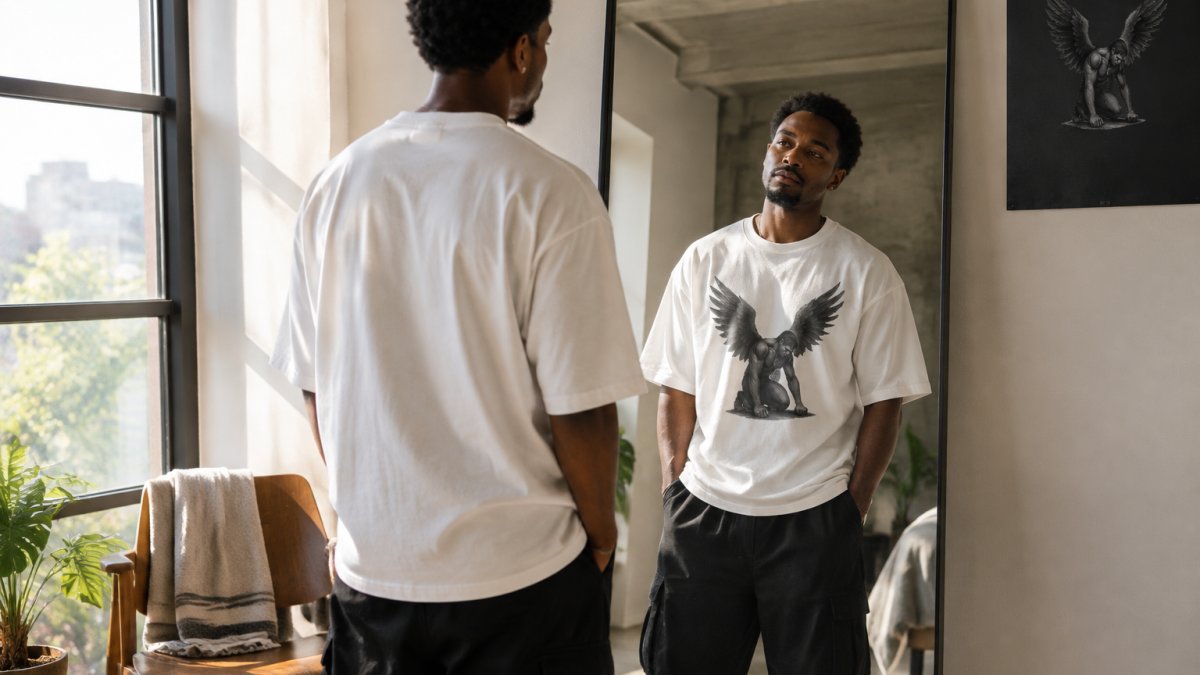
Start with one garment that carries meaning for you. The Destined 4 Greatness Eagle Graphic Tee ($75.00) works because its oversized cut and vintage-style eagle emblem read as deliberate rather than loud. Pair it with a morning intention, and the shirt becomes part of a ritual rather than an outfit.
2. Overcoming Limiting Beliefs Through Identity
Many people find that limiting beliefs can loosen when their self-image changes. When you decide who you are, old patterns lose their grip.
This is the core of How To Tap Into Your Divinity, which examines how fear, conditioning and inherited beliefs shape behaviour, and how self-awareness and accountability loosen them. The book pairs well with a wardrobe decision: choose clothing that reflects the identity you are moving toward, not the one you are leaving behind.
Watch out: buying pieces to become someone new, rather than to affirm who you already are, turns the practice into consumption. Anchor the purchase to a belief you are actively working on.
3. Build a Values-Driven Wardrobe That Reflects Core Values
A values-driven wardrobe starts with an audit, not a shopping list. Many people own more than they regularly wear. The audit closes that gap, and it is the step almost every article on this topic skips in favour of philosophy.
Begin with the values themselves. Write down three, not ten. Good candidates are things you would defend under pressure: honesty, discipline, resilience, service, creativity, loyalty, courage.
Then run the audit in four passes.
Destined 4 Greatness Eagle Hoodie — Motivational Streetwear Pullover →
Pass one, the wear count. Pull out everything you have worn in the last ninety days. The rest is not automatically wrong, but it is data. A garment you have not reached for in a season is either misaligned with your values or misaligned with your life, and both are worth knowing.
Pass two, the value test. For each remaining garment, ask a single question: which of my three values does this express, and how? If the answer is 'it looks good', that is fine, but it is aesthetics, not values, and it belongs in a different category. Be honest about the difference.
Pass three, the cue test. Put the garment on and notice what it makes you want to do. Does it make you want to move, to work, to show up? Or does it make you want to hide, to compare, to scroll? Clothing cues behaviour, and the cue matters more than the cut.
Pass four, the gap. Which of your three values has no garment attached to it? That is the only place a new purchase is justified. One intentional piece that fills a real gap beats five that fill none.
| Pass | Question | Action |
|---|---|---|
| 1. Wear count | Have I worn this in ninety days? | Keep, repair or release |
| 2. Value test | Which of my three values does this express? | Name it or reclassify as aesthetics |
| 3. Cue test | What does wearing this make me want to do? | Keep the cues that serve you |
| 4. Gap | Which value has no garment? | Add one intentional piece |
Repeat the audit each season, because values shift as the inner work progresses. A value you held two years ago may now be a value you have outgrown, and the wardrobe should follow rather than lead.
When you are ready to act on the results, browse the modern men's clothing range for pieces built around confidence and purpose. The Destined 4 Greatness Eagle Graphic Tee ($75.00) is a useful example of a gap-filler: its oversized cut and vintage-style eagle emblem read as deliberate rather than loud, which makes it a cue for steadiness rather than noise.
Watch out: using the audit as a justification to buy. The purpose of the gap pass is to identify the one piece that fills a real absence, not to generate a shopping list. If the audit produces more than one gap, the values list is too long, cut it back to three.
4. Books for Spiritual Awakening and Healing to Pair With Your Practice
Clothing can hold a symbol. Books do the reconstruction. For readers drawn to awakening and healing, three titles from Lene Fepuleai are worth pairing with the wardrobe work.
Perspectives of the Analytical Mind examines how culture, authority and inherited belief shape perception, and invites readers to reason independently. Sacred Scars traces adversity, spiritual encounter and healing as a path to wisdom. Read together, they turn self-expression into self-examination.

5. The Psychological Impact of Uniforming and Intentional Dressing
Uniforming is the deliberate reduction of daily clothing decisions to a small, meaningful set. The psychological benefit is decision fatigue removed and identity reinforced.
Intentional dressing takes this further: every piece earns its place. A small set of purposeful garments can bring more clarity than a crowded wardrobe. The Gold Eagle Graphic Pullover ($100.00) suits this approach, with a relaxed fit and understated gold emblem.
6. Sustainable and Ethical Production as a Personal Value
Conscious consumerism begins with durability. A garment that lasts is a value statement, not a compromise. Research from ResearchGate on fashion resale and sustainable consumption links resilience to sustainable consumption habits and self-improvement practices, suggesting the two reinforce each other.
Practical test: check construction before price. The Eagle Hoodie ($100.00) uses an 80% cotton, 20% polyester blend with ribbed cuffs and a tear-away label.
Start With One Intentional Piece
The challenge is not finding meaningful clothing. It is choosing it deliberately, then letting it remind you daily of the work you are doing inward. Destined 4 Greatness pairs resilient streetwear with soul-shifting books so the outside matches the inside: garments built for repeated wear, writing that supports healing, and a mindset strengthened one choice at a time. Get started with Destined 4 Greatness and dress for the person you are becoming.
Frequently Asked Questions
How does clothing influence personal development?
Clothing works as a constant, visible cue. Fashion can contribute to self-concept, though it is limited by the external nature of the product compared with internal psychological work. That limitation is the point: resilient streetwear is most useful when it sits alongside reflection, reading and habit change. A piece that carries a message you chose deliberately can prompt the behaviour you are already working on, rather than substituting for it.
What is intentional fashion in the context of spiritual growth?
Intentional fashion means choosing each piece for a reason you can name: a value, a reminder, a stage of your journey. It rejects buying on impulse or trend. In spiritual terms, it is the outer layer of inner work. Pair a deliberate wardrobe with a book such as How to Tap Into Your Divinity, which explores self-awareness, intuition and moving beyond conditioned thinking, and the clothing becomes a daily anchor for the reflection you are doing on the page.
How can apparel serve as a reminder of personal resilience?
A garment becomes a reminder when its design carries meaning you assigned to it. An eagle emblem, for instance, can stand for perspective and rising after a setback. The reminder works through repetition: you see it each morning and it reconnects you to a decision you already made about who you are becoming. Sacred Scars explores how painful experiences become pathways to wisdom, and wearing something that honours that survival keeps the lesson close rather than buried.
How do I align my daily wardrobe with my spiritual values?
Start with an audit. Pull out everything you wear regularly and ask three questions of each piece: does it reflect a value I hold, does it support how I want to feel, and would I choose it again today? Anything that fails all three goes. Then fill the gaps deliberately, choosing pieces whose message matches the inner work you are doing. Add sustainable and ethical production to your criteria, and let the wardrobe shrink to a smaller set of pieces you actually mean.
