

Streetwear That Represents Personal Values, Not Trends
Last Updated: November 4, 2026
Quick Summary
Streetwear that represents personal values starts with naming three values you actually hold, then auditing what you already wear against them. Buy only to fill a gap the audit identifies, so each piece signals a value rather than a trend cycle.
- Write down three values, not ten; anything untraceable to them is decoration, not identity.
- Rate your wardrobe one to five per value to measure the gap between stated and worn values.
- A symbol stops working when it is detached from the life behind it.
- Ask whether you would still wear a piece in five years before buying it.
- The brand pairs its apparel with three books by Lene Fepuleai that underpin the graphics.
Table of Contents
- Why Streetwear Became a Language of Identity
- How to Align Your Identity With Your Clothing
- Apparel That Supports Personal Growth Through Daily Affirmation
- The Psychology of Streetwear Symbolism and Social Signalling
- Six Pieces of Streetwear That Represent Personal Values
- Conscious Consumerism and the Ethics Behind What You Wear
- Reading the Books Behind the Graphics
- Build Your Intentional Wardrobe With Destined 4 Greatness
- Frequently Asked Questions
Why Streetwear Became a Language of Identity
Streetwear that represents personal values has moved from subculture curiosity to mainstream force. The global streetwear market reached AUD 325.5 billion in 2026, according to SourceReady's market valuation, and it is projected to reach AUD 1.1 trillion by 2034 per Fortune Business Insights.
Streetwear is a visual language in which graphics, silhouettes and emblems communicate identity, values and belonging without a word being spoken. At Destined 4 Greatness, the view is that this language should carry meaning rather than trend cycles. Research from the LIACS thesis repository on streetwear and the self found that personal clothing style embodies the true self, represents the ideal self, and expresses the creative self. In other words, what a person wears is rarely accidental.
Below, this guide breaks down how to align identity with clothing, what the psychology of symbolism actually does, and six pieces that carry a message worth wearing.
How to Align Your Identity With Your Clothing
Alignment starts with honesty, not shopping. A 2024 study in MDPI on personal values and clothing style confidence found that personal values and clothing style confidence significantly influence interest in intentional fashion choices.
Most wardrobe advice stops at "buy less, choose well". That is not a framework. What follows is a repeatable audit that moves from stated values to worn values, then resolves the conflicts between them.
Step 1: Name Three Values, Not Ten
Values need names before they can be worn. Resilience, faith, growth, honesty, creativity, discipline and community are all signals a garment can carry. Write down three. Anything that cannot be traced to one of those three is decoration, not identity.
This is where How to Tap Into Your Divinity is useful.
Step 2: Audit What You Already Wear
Before buying anything, look at what gets worn most. Most people discover their real values are already visible in the pieces they reach for without thinking. Ask three questions of each item: Does this feel like me, or like a version of me I performed? Would I wear this if nobody recognised the label?
A simple three-column audit works well:
- Keep: pieces that feel true and get worn weekly
- Question: pieces bought for a trend, an event, or someone else's approval
- Release: pieces that contradict the values a person wants to signal
Step 3: Score the Gap
Naming and sorting is not enough; the gap has to be measured. For each of the three named values, rate the current wardrobe from one to five on two questions: how many pieces genuinely carry that value, and how often those pieces are worn. A value scored high on presence but low on wear is a costume, not a commitment.
Step 4: Resolve the Conflicts
Most people find at least one contradiction. A wearer who names sustainability as a value but owns a drawer of fast-fashion graphic tees has a conflict, and so does a wearer who names humility but reaches for the loudest logo in the wardrobe.
Watch out: an audit that ends in a shopping list has failed. The purpose is to identify what is already working and to stop the accidental accumulation that built the wardrobe in the first place.
Step 5: Buy Only to Fill a Named Gap
Once the values are named, the wardrobe is scored and the conflicts are resolved, purchases become narrow. A new piece is justified only when it fills a gap the audit identified, a value with low presence, or a worn-out piece that carried a value well.
The graphics carry more weight when the thinking behind them is available. Perspectives of the Analytical Mind examines how culture, authority and inherited beliefs shape identity, which is the same question the audit asks of a wardrobe: which of these choices are actually mine, and which were absorbed from somewhere else?
Apparel That Supports Personal Growth Through Daily Affirmation
What a person puts on in the morning sets the tone for the hours that follow. Apparel that supports personal growth works as a daily affirmation: a repeated visual cue that reinforces who the wearer is becoming.
Destined 4 Greatness builds its pieces around this idea. The brand pairs resilient streetwear with written works, so the clothing and the inner work reinforce each other. Customer Jason M. put it plainly: the shirt "doesn't just look good, it inspires good."
The Psychology of Streetwear Symbolism and Social Signalling
Symbolism is how streetwear does its quiet work. An emblem, a wordmark, a colour choice all function as social signalling: a non-verbal message about who the wearer is and which community they belong to.
The 2026 data backs this up. Multiversity Store's Gen Z streetwear analysis reports that identity, originality, resale, community and discovery are the core forces shaping consumption for that generation, who are 1.5 times more likely to buy streetwear than any other group. The signal matters more than the label.
Why a Symbol Works, and When It Stops Working
The mechanism is repetition. A symbol carries weight because the wearer sees it every time they dress, and the people around them learn to read it.
The mechanism also explains the failure mode. A symbol stops working when it is detached from the life behind it. EVRMORE's analysis of values-based fashion warns of "mixed messages" when a brand's identity is unclear or relies on superficial symbolism.
The Uniforming Problem
There is a tension the trend data does not capture. Streetwear is a uniform as much as it is an expression, and the pressure to conform to a look, the right silhouette, the right logo, the right drop, can quietly override the values a person set out to signal.
The test is simple. If a piece would still be worn after the trend cycle moved on, it is expression. If it would be retired the moment the scene changed, it was uniforming.
Destined 4 Greatness Eagle Graphic Tee — Oversized Men’s Streetwear T‑Shirt →
Reading the Signal Before You Send It
Before buying a graphic, read it the way a stranger would. What does the emblem say to someone who does not know the brand? What does it say to someone who does?
This is where Sacred Scars is relevant. Its exploration of adversity, survival and spiritual discernment is a study in how painful experience becomes a pathway to wisdom, and how a person learns to tell the difference between a symbol that carries meaning and one that merely decorates.
Six Pieces of Streetwear That Represent Personal Values
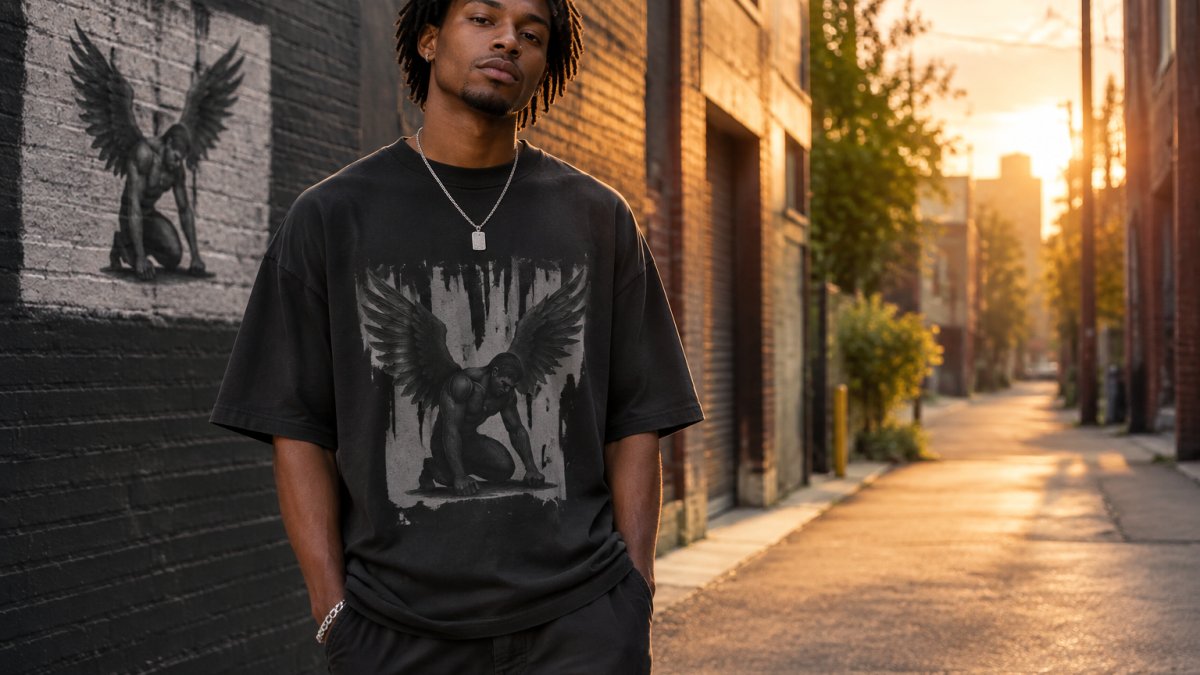
Each piece below carries a specific signal. The point is not to collect all six, but to choose the one or two that match the values named earlier.
1. The Oversized Eagle Tee for Grounded Confidence
The Eagle Graphic Tee is an oversized tee with a bold, vintage-inspired graphic across the chest and a small emblem at the nape. Its relaxed, roomy silhouette signals confidence without noise.

Best for: anyone who wants a statement piece that reads calm rather than loud. Skip if: a close, tailored fit is the preference.
2. The Vintage Angel Wing Tee for Wearable Memory
The Vintage Angel Wing Logo Tee has a garment-dyed, lived-in finish, with a gothic-inspired wordmark on the front and a minimalist emblem on the back. It carries the idea that a garment can hold memory, including the harder chapters that shaped a person.

Best for: wearers who want understated attitude with personal meaning. Skip if: crisp, bright colour is the goal.
3. The Gold Eagle Hoodie for Quiet Intent
The Gold Eagle Graphic Pullover sets warm gold tones against a clean white base, with a refined script and small winged figure. Its relaxed fit reads thoughtful. This is the piece for someone who prefers understated symbolism.

Best for: quiet, everyday intent. Skip if: bold colour is the preference.
4. The Motivational Eagle Hoodie for Everyday Momentum
The Motivational Eagle Hoodie pairs a white canvas with compact black graphics, a stylised wordmark across the chest and a small winged emblem on the upper back. A roomy kangaroo pocket makes it an easy daily layer.
Best for: a repeat-wear piece that reinforces daily intention. Skip if: a heavier winter layer is needed.
5. The Angel Logo Hoodie for Visible Commitment
The Angel Logo Hoodie uses a bright red canvas with a crisp white emblem front and back. It reads like a badge, which suits a wearer who wants their commitment visible rather than implied.
Best for: visible, confident commitment. Skip if: a neutral palette is preferred.
6. The White Oversized Tee for Deliberate Simplicity
The Oversized White Shirt has a gold emblem and lettering across the chest. It is the simplest piece in the range, and simplicity is itself a value statement.
Best for: deliberate minimalism. Skip if: a graphic-heavy look is wanted.
| Piece | Price (AUD) | Signal | Best For |
|---|---|---|---|
| Oversized Eagle Tee | $75 | Grounded confidence | Statement simplicity |
| Vintage Angel Wing Tee | $75 | Wearable memory | Understated attitude |
| Gold Eagle Hoodie | $100 | Quiet intent | Everyday symbolism |
| Motivational Eagle Hoodie | $100 | Daily momentum | Repeat wear |
| Angel Logo Hoodie | $100 | Visible commitment | Bold statement |
| White Oversized Tee | $75 | Deliberate simplicity | Minimalist wardrobes |
Conscious Consumerism and the Ethics Behind What You Wear
Every purchase is a vote. Conscious consumerism means asking what a garment endorses: the labour behind it, the message on it, and the lifespan it offers.
A practical test before any purchase: can the buyer name the value the piece signals, and would they still wear it in five years? If both answers are yes, the purchase is intentional. If either is no, it is a trend purchase in disguise.
Reading the Books Behind the Graphics
The graphics carry more weight when the thinking behind them is available. Destined 4 Greatness publishes three books by Lene Fepuleai, and each one underpins a different part of the brand's message.
How to Tap Into Your Divinity is the practical guide to self-discovery, inner healing and personal transformation, covering limiting beliefs, emotional conditioning and self-accountability.
Build Your Intentional Wardrobe With Destined 4 Greatness
The challenge is simple: most wardrobes are built by accident, one trend at a time. Building one on purpose takes three named values, an honest audit, and pieces that carry a message worth repeating. Destined 4 Greatness pairs resilient streetwear with soul-shifting written works, so the clothing and the inner work move together.
Frequently Asked Questions
How can clothing reflect personal values?
Clothing reflects personal values through the symbols, words and silhouettes you choose to wear in public. Personal style can express the true self, the ideal self and the creative self. When you pick a garment deliberately, you are making a non-verbal statement about what you stand for. A piece carrying an affirmation or emblem tied to your growth becomes a form of visual communication, telling others and reminding yourself what matters most to you.
What is intentional fashion in the context of personal development?
Intentional fashion means choosing each piece because it aligns with your core values rather than because a trend told you to. Personal values and confidence in how you dress can shape your interest in intentional fashion choices. In practice, it means asking whether a garment supports the person you are becoming. Destined 4 Greatness builds this into its range, pairing streetwear with books such as How to Tap Into Your Divinity so the clothing and the inner work reinforce each other.
How does streetwear support a journey of self-discovery?
Streetwear supports self-discovery because it sits at the intersection of subculture, self-expression and community. Many younger shoppers are drawn to identity, originality and community when they buy streetwear. Wearing apparel that represents personal values gives you a daily prompt to check in with yourself. Pairing that with reflective reading, such as Perspectives of the Analytical Mind, turns the wardrobe into part of a wider practice of questioning inherited beliefs and building independent reasoning.
How can your outfit serve as a daily affirmation?
An outfit becomes a daily affirmation when the message on it matches the mindset you are trying to hold. A graphic that reads as a statement of greatness works as a reminder every time you catch your reflection. The psychology is straightforward: repeated visual cues shape self-perception over time. Choose pieces whose wording or symbolism you would be comfortable repeating to yourself out loud, and the garment stops being decoration and starts being a tool for self-actualisation.
