

Streetwear Trends for Personal Growth: 2026 Guide
Last Updated: November 4, 2026
Quick Summary
Streetwear trends for personal growth in 2026 shift focus from logos to meaning, with the global streetwear market valued at AUD 618.45 billion. You build a values-driven wardrobe by naming three to five core values, scoring each garment against them, and pairing the practice with books like How to Tap Into Your Divinity.
- Score each garment 0-2 on value match, wear frequency, condition and emotional charge; 4 or below is a removal candidate.
- Attach one affirmation to a specific piece worn on a set schedule, then review your self-talk after 30 days.
- Use the one specific piece rule: add a single value-carrying item to your usual outfit and notice how you feel.
- Basico Branco's 2026 observations show buyers favouring high-quality basics designed for longevity over disposable trends.
- Perspectives of the Analytical Mind examines how authority, culture and education shape what people accept as their own taste.
Table of Contents
- Why 2026 Streetwear Is Turning Toward Personal Growth
- The Psychology of Streetwear Symbolism and Self-Expression
- Building a Values-Driven Wardrobe That Reflects Core Values
- Books for Personal Transformation and Healing to Pair With Your Practice
- Practising Shadow Work for Self-Awareness Through What You Wear
- How to Use Affirmations in Daily Life With Intentional Streetwear
- Sustainable and Ethical Production as a Personal Value
- Individual Expression vs. Societal Norms: The Psychological Impact of Uniforming
- Frequently Asked Questions
Why 2026 Streetwear Is Turning Toward Personal Growth
Personal growth is no longer confined to journals and therapy rooms. It has moved into what people wear. According to Fortune Business Insights' 2026 streetwear market analysis, the global streetwear market is valued at AUD 618.45 billion in 2026, and the conversation inside it has shifted from logos to meaning.
The shift is measurable. McKinsey & Company's State of Fashion 2026 projects only low single-digit growth for the wider fashion industry this year, which means brands can no longer rely on novelty alone. Consumers are asking harder questions about what a garment says, who made it, and whether it aligns with their values.
That is the throughline of this article: streetwear in 2026 is less about following a trend and more about declaring an identity. Below, we break down the psychology, the practical wardrobe audit, and the books that pair with the practice.
The Psychology of Streetwear Symbolism and Self-Expression
Streetwear symbolism is the use of graphics, emblems, silhouettes and colour to communicate identity and values without speaking. A winged emblem on a hoodie is visual communication, and the wearer chooses it the way they choose a sentence.
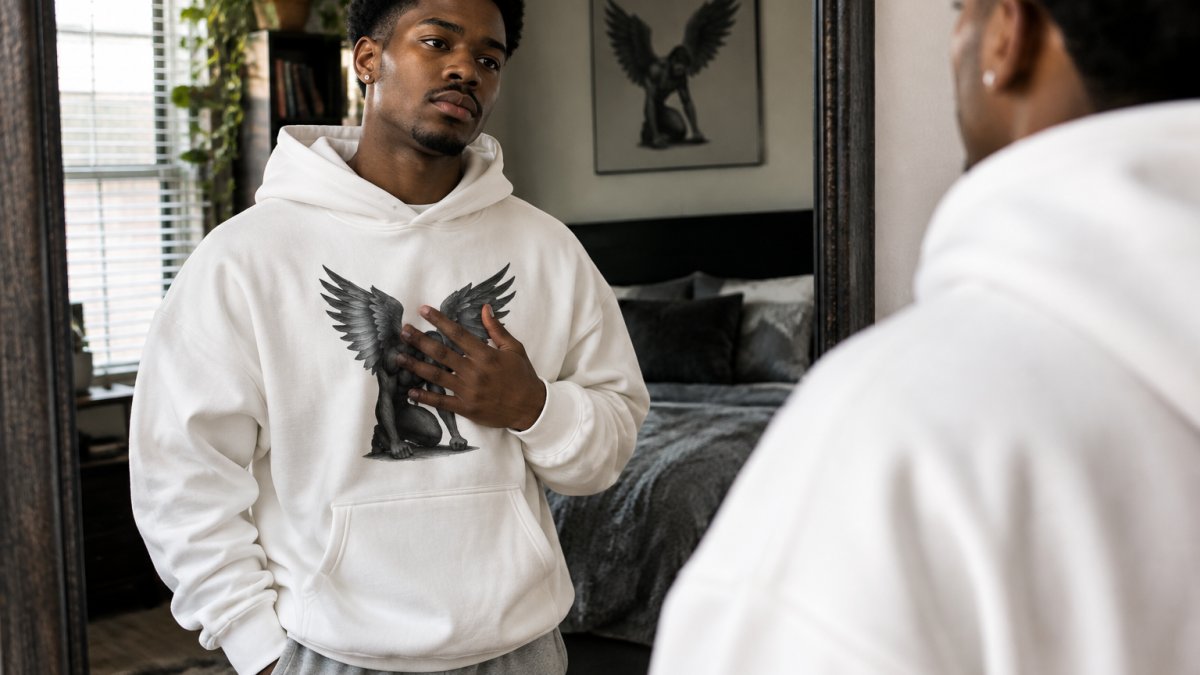
The psychology behind this is straightforward. Style Analytics' 2026 consumer research found that consumers now prioritise individual expression and personal style conversations over generic fashion cycles.
What most guides miss is that this only works when the symbol is chosen deliberately. A graphic picked because it looked good in a feed says nothing. A graphic picked because it names a value you are actively building says plenty.
Building a Values-Driven Wardrobe That Reflects Core Values
A values-driven wardrobe is a collection of garments selected against written core values rather than trends. It replaces impulse with intention, and it starts with a list, not a shopping cart. Most guides stop there. The difference between a wardrobe that reflects values and one that merely aspires to is the quality of the audit behind it.
The first step is naming three to five values you want your clothing to carry. Examples include resilience, authenticity, discipline, creativity or community. But naming is not enough. Each value needs a behavioural definition, because 'authenticity' means nothing until you decide what it looks like on a Tuesday morning. Write one sentence per value describing how it shows up in what you wear. That sentence becomes your filter.
For a deeper look at how intentional dressing supports personal evolution, read Intentional Fashion Matters for Growth.
A Practical Audit Framework for Your Current Rotation
Use this four-part audit on everything already hanging in your wardrobe. Unlike a simple checklist, each part produces a score you can act on.
- Value match (0-2): Can you name the value this piece signals, and does it match one of your written values? Score 2 if yes, 1 if the value is vague, 0 if you cannot name one. A zero is decoration, not identity.
- Wear frequency (0-2): Has it been worn in the last 90 days? Score 2 for regular wear, 1 for occasional, 0 for unworn. Unworn pieces are not neutral; they take up the space and attention a value-aligned piece could occupy.
- Condition (0-2): Does it still hold shape, colour and structure? Score 2 for excellent, 1 for visible wear, 0 for failing construction. Worn-out pieces undermine the message they were chosen to carry.
- Emotional charge (0-2): Does wearing it make you stand taller or shrink? Score 2 for confidence, 1 for neutral, 0 for discomfort. That answer is data, not mood.
Total the scores. Anything scoring 4 or below is a candidate for removal. Anything scoring 6 or above earns its place. The middle band (5) is where most wardrobes hide their unresolved decisions, and those are the pieces worth examining first.
Watch out: the audit only works if you are honest about the emotional charge. Most people over-score pieces they spent a lot on, because cost creates a loyalty that has nothing to do with values.
The goal is not a smaller wardrobe for its own sake. That standard is the same one How to Tap Into Your Divinity applies to habits and beliefs: name what you are actually building, then remove what does not serve it.

Books for Personal Transformation and Healing to Pair With Your Practice
Reading is the other half of the practice. Clothing carries the message outward; books do the work inward. Three titles sit naturally alongside a values-driven wardrobe.
How to Tap Into Your Divinity is the practical starting point. Lene Fepuleai writes about self-awareness, emotional resilience, limiting beliefs and the difference between the ego and the deeper self, which is exactly the groundwork a values-driven wardrobe rests on.
Perspectives of the Analytical Mind asks harder questions about conditioning, perception and inherited beliefs. It suits anyone auditing their wardrobe and discovering that half their choices were never really theirs.

For readers whose healing came through pain rather than theory, Sacred Scars traces how adversity, betrayal and survival can become pathways to wisdom. It reframes the scars a person carries as evidence of survival rather than damage.
Practising Shadow Work for Self-Awareness Through What You Wear
Shadow work is the practice of examining the parts of yourself you have pushed out of view. Clothing is an unusually honest mirror for it, because the wardrobe records decisions made in states you may not remember.
Destined 4 Greatness Eagle Hoodie — Motivational Streetwear Pullover →
Start with the pieces you avoid. The jacket bought for a version of yourself that never arrived. The shirt that felt like a costume. The colour you never wear because someone once commented on it.
A common mistake is treating shadow work as a mood exercise. In practice, it means writing down what you felt when you last wore the piece, and asking whose voice that feeling belongs to. Often it is not yours.
Perspectives of the Analytical Mind is built for exactly this kind of questioning, particularly on how authority, culture and education shape what people accept as their own taste. Pair the reading with the audit and the patterns surface quickly.
How to Use Affirmations in Daily Life With Intentional Streetwear
Affirmations work best when they are encountered repeatedly in ordinary moments. A garment is one of the few objects a person sees and touches dozens of times a day, which makes intentional streetwear a practical delivery system rather than a gimmick.
The method is simple:
- Choose one affirmation tied to the value you are currently building.
- Attach it to a specific piece you wear on a set schedule, not every day.
- Repeat it silently each time you put the piece on or notice the emblem.
- Review after 30 days and note what changed in your self-talk.
The Destined 4 Greatness Eagle Hoodie, Motivational Streetwear Pullover suits this practice well. Its compact black wordmark and small winged emblem sit quietly on a white canvas, so the reminder is present without being loud. Its kangaroo pocket and ribbed cuffs make it a practical everyday piece.

Sustainable and Ethical Production as a Personal Value
Conscious consumerism is one of the values most often named and least often practised. A wardrobe built for longevity is the practical version of it, and it changes what deserves space in the rotation.
Basico Branco's 2026 market observations note that buyers are favouring high-quality basics and apparel designed for longevity over disposable trends. That aligns with what the Fashion Scholarship Fund's 2026 trend report describes as a consistent industry starting point: function, comfort and personal expression.
In practice, this means choosing garments with construction that survives repeated wear. The Destined 4 Greatness Eagle Graphic Tee, Oversized Men's Streetwear T-Shirt is built with shoulder-to-shoulder tape to stabilise the neck and double-needle stitched hems for durability.
Individual Expression vs. Societal Norms: The Psychological Impact of Uniforming
Uniforming is the quiet drift toward dressing like everyone in your social or professional circle. It feels safe, and it costs something: the visual signal that once distinguished you goes flat.
The pressure is real. Social signalling runs in both directions, and most people calibrate their clothing to avoid standing out rather than to express anything.
The cost is subtler than lost style. When clothing stops carrying a personal signal, it also stops functioning as a daily reminder of the values a person is trying to build.
The counter-move is not loudness. It is specificity. A single deliberate emblem, a considered silhouette or a piece with a story behind it does more than an entire outfit of statement pieces.
A practical way to test whether you are uniforming or choosing is the 'one specific piece' rule.
Current 2026 style directions help here.
| Wardrobe Habit | What It Signals | Practical Fix |
|---|---|---|
| Trend-led purchases | Following, not choosing | Buy against a written value list |
| Logo-heavy outfits | Borrowed identity | One deliberate emblem per outfit |
| Avoided pieces | Unresolved beliefs | Run the shadow work audit |
| Worn-out staples | Low self-regard | Replace with durable construction |
| Uniform dressing | Conformity response | Add one specific, personal piece |
| Overcorrecting into loudness | Performance, not identity | Test one piece at a time |
The deeper pattern is that uniforming is rarely about clothing at all.
Frequently Asked Questions
How can clothing support personal growth and spiritual development?
Clothing works as a daily prompt. A piece you chose deliberately, rather than grabbed in a rush, reminds you of the person you are practising becoming. That is the core idea behind streetwear trends for personal growth in 2026: the garment becomes a cue for self-awareness rather than decoration. Pair that with a reflective practice from How to Tap Into Your Divinity, such as morning intention-setting, and the reminder lands every time you reach for the piece. The clothing does not do the inner work, but it keeps the commitment visible.
What is intentional fashion and how does it relate to self-discovery?
Intentional fashion means every piece in your rotation earns its place. You ask three questions before buying: what value does this represent, when will I actually wear it, and does it hold up over repeated wear. That process is itself self-discovery, because you cannot answer those questions without knowing what you stand for. Practising shadow work for self-awareness helps here too, since it surfaces the inherited beliefs behind impulse purchases. The result is a wardrobe that tells the truth about you rather than a trend report.
How do I align my personal style with my inner transformation?
Start with one value you are actively working on, such as resilience or honesty, and choose one visible piece that represents it. A heavyweight oversized tee or a midweight hoodie with an emblem you find meaningful works well because you see it daily. Then keep a short note of how wearing it changed your behaviour that day. Over weeks, the link between the garment and the value strengthens. Books for personal transformation and healing give you the language to name what is shifting, so the outer change tracks the inner one.
How can apparel serve as a reminder of my commitment to healing and resilience?
Apparel works as a reminder when the symbol means something specific to you. A winged emblem, a wordmark, a colour you associate with a hard season survived: any of these can function as a private cue. The Destined 4 Greatness Eagle Hoodie, for example, carries a small winged emblem on the upper back, which sits out of your own eyeline and in everyone else's. That is useful if you want the reminder to shape how you show up publicly rather than become a private ritual.
